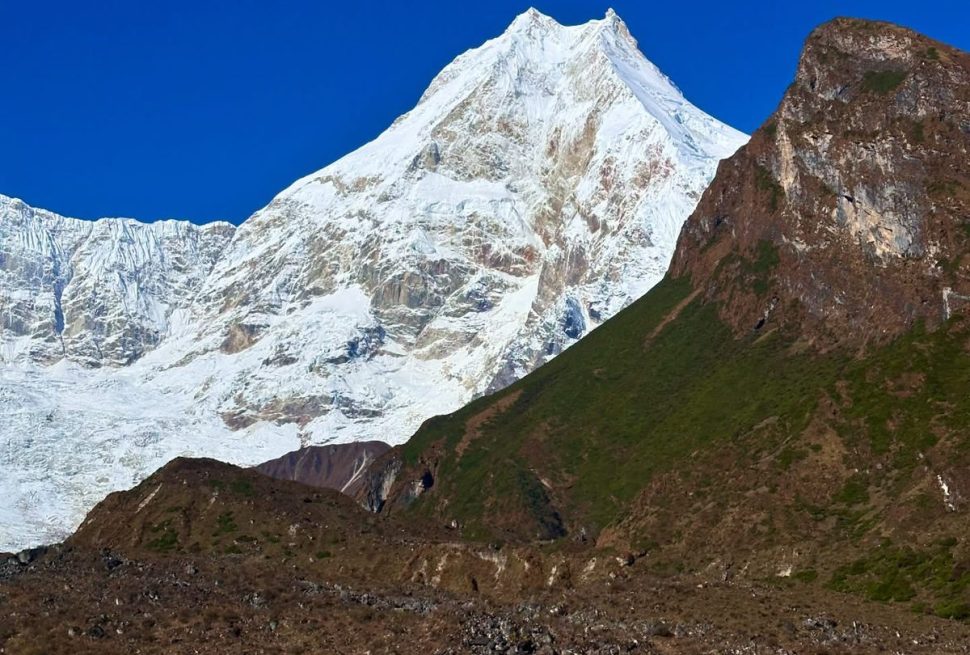
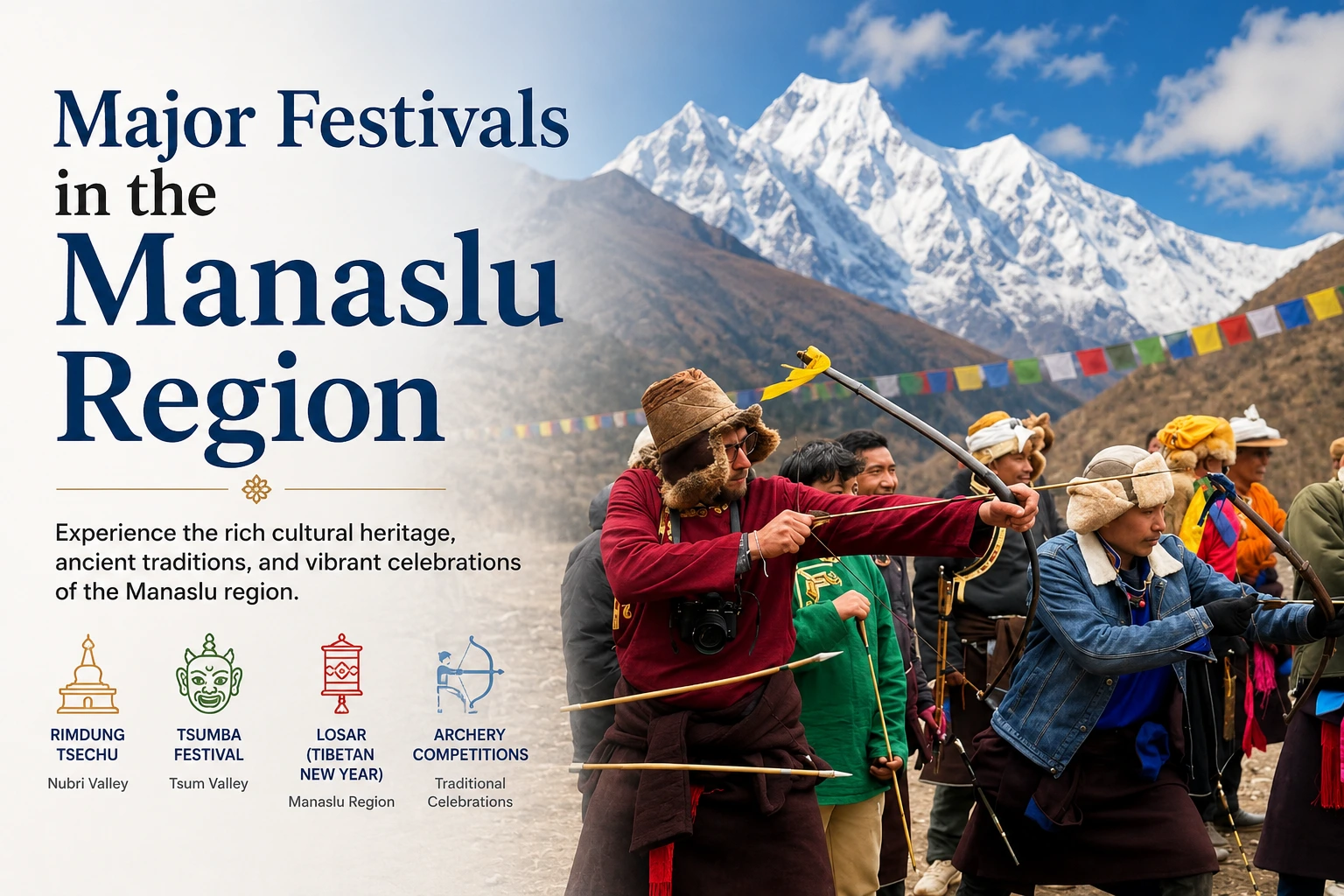
The Manaslu Circuit Trek is one of the few trekking routes in the world where the cultural calendar is as rich as the mountain scenery. The Nubri and Tsumba communities of the upper Budhi Gandaki valley and the Tsum Valley have maintained their Tibetan Buddhist festivals for centuries with a continuity that even the more famous Sherpa communities of the Everest region cannot quite match. These are not performances put on for tourists. They are the living religious and social events that hold these remote communities together across the generations. Contact our manaslu trek company for competitive pricing and guaranteed departures.
Timing your trek to coincide with a major festival is one of the most rewarding decisions you can make as a Manaslu trekker. Walking into Samagaun during the Tiji Festival, watching monks in full ceremonial silk robes and painted masks perform ancient ritual dances with Manaslu filling the entire northern sky — this is not an experience that any amount of planning can adequately prepare you for. You simply have to be there.
This guide covers every significant festival observed in the Manaslu Circuit region, from the Tibetan Buddhist monastery festivals of the high valley to the Hindu national festivals of the lower trail communities, with cultural context, approximate dates, and practical information on how to plan your Manaslu Circuit Trek around the celebration that matters most to you.
The Manaslu Region Festival Calendar at a Glance
| Festival | Approximate Month | Location | Tradition | Significance |
|---|---|---|---|---|
| Losar | Jan / Feb | All upper valley villages | Tibetan Buddhist | Tibetan New Year — most important community festival |
| Cham Dance — Lho | April / May | Ribung Gompa, Lho (3,180m) | Nyingma Buddhist | Masked ritual dance, deity invocation, spring protection |
| Tiji Festival (Tenchi) | April / May | Pungyen Gompa, Samagaun (3,520m) | Nyingma Buddhist | Most spectacular festival — three days of Cham dance |
| Saga Dawa | May / June | All monasteries | Tibetan Buddhist | Buddha’s birth, enlightenment, and passing — holiest month |
| Yartung | August | Samagaun and Samdo | Tibetan / Bon | Horse racing, end of summer, community games |
| Nubri Harvest Festival | September / October | Lho, Samagaun, Namrung | Traditional Nubri | Barley and buckwheat harvest celebration |
| Dashain | October | Lower valley — Jagat, Philim, Soti Khola | Hindu (Nepali) | Nepal’s biggest national festival — goddess Durga |
| Tihar (Deepawali) | October / November | Lower valley villages | Hindu (Nepali) | Festival of lights — five-day Hindu celebration |
| Mani Rimdu | November | Upper valley monasteries | Nyingma Buddhist | Three-day monastery festival, Cham dance, community blessing |
| Tsum Valley Tshechu | Varies | Serang Gompa, Mu Gompa (Tsum Valley) | Nyingma / Kagyu Buddhist | Tsum Valley annual monastery festival — rarely witnessed by outsiders |
Tiji Festival (Tenchi) — The Crown of the Manaslu Festival Calendar
Tiji — known in Tibetan as Tenchi, meaning “the chasing away of the demon” — is the single most significant religious festival in the Nubri valley and among the most visually extraordinary festival experiences available anywhere on a Nepal trekking route. It takes place over three consecutive days at Pungyen Gompa in Samagaun, typically in late April or early May according to the Tibetan lunar calendar, and the timing shifts by several weeks from year to year.
The festival dramatises the legend of Dorje Jono, the son of a demon who threatened the Manaslu valley with drought, destruction, and famine. According to Nubri religious tradition, Dorje Jono, despite being the offspring of the demon, chose to resist his father’s evil nature. Through a series of battles, transformations, and ultimately a form of self-sacrifice and divine intervention, he defeated the demon and restored the valley’s prosperity and spiritual wellbeing. The three-day Cham dance performance re-enacts this story through movement, mask, music, and sacred ritual.
What Happens During Tiji
On the first day, the monastery courtyard at Pungyen Gompa fills with the entire Samagaun community dressed in their finest traditional clothing. Women wear striped aprons and elaborate silver jewellery. Men wear long woollen robes and fur-lined hats. Monks from Pungyen Gompa and from affiliated monasteries in Kathmandu, India, and Tibet who have travelled back for the occasion fill the monastery and its surrounding terraces.
The Cham dances begin after the morning prayer ceremony. The monk dancers wear painted wooden masks representing the major figures of the legend — protective deities with multiple arms and fierce expressions, demons with long tusks and rolling eyes, and the heroic Dorje Jono himself whose mask combines both demon and divine features. The costumes are made of heavy silk brocade in deep reds, blues, golds, and greens, with fabric crowns, long sleeves that extend beyond the hands, and elaborate decorations that have been maintained and repaired across generations.
The dances are accompanied by the full monastery orchestra: the deep boom of the large monastery drums, the clashing of hand cymbals, the wail of the gyaling (a short oboe-like horn), and the resonant drone of the dungchen — the long ceremonial horn that can be heard from the other side of the valley. Each dance sequence lasts between twenty minutes and over an hour, and the complete programme across all three days runs from early morning until late afternoon.
On the second day, the dances move toward the climax of the narrative — the confrontation between Dorje Jono and his demon father. This is the most dramatic performance of the three days, with a larger cast of dancers and a faster, more intense musical programme. Members of the community participate in specific roles at the edges of the courtyard, responding to the drama with ritual gestures and prayers.
On the third and final day, the demon is defeated. A torma — a ritual cake made from barley flour and butter and shaped into the form of the demon — is brought out into the courtyard and ceremonially destroyed by the head Lama of Pungyen Gompa. This act completes the ritual defeat of the evil force and ensures the valley’s protection and prosperity for the coming year. The community celebration that follows this moment — the relief, the laughter, the communal sharing of food and chang (barley beer) — is one of the most genuinely joyful social events imaginable.
Losar — Tibetan New Year
Losar is the Tibetan New Year and the most widely observed festival across all the Nubri and Tsumba communities of the Manaslu region. Unlike the monastery-centred festivals of spring and autumn, Losar is fundamentally a family and community celebration — a time when the entire social fabric of the high-altitude villages is renewed and reaffirmed through shared ritual, food, prayer, and festivity.
Losar falls on the first day of the first month of the Tibetan lunar calendar, which corresponds to late January or February in the Gregorian calendar. The exact date shifts each year and occasionally Tibetan communities in different areas celebrate Losar on slightly different days due to regional calendar variations. In the Nubri valley, the celebrations typically last three formal days, though informal festivities continue for up to two weeks as different households host successive rounds of communal gatherings.
Preparations Before Losar
The week before Losar is as important as the festival itself. Households throughout the upper Manaslu valley undergo thorough cleaning — both physical and spiritual. Every room in every home is swept and scrubbed. Old prayer flags are taken down and new ones prepared for installation. Juniper branches are cut and laid across doorways and window ledges to purify the home with their scent and their spiritual properties. New batches of chang (barley beer) are fermented. Families prepare large quantities of khapse — deep-fried butter cookies in elaborate shapes — that are both offerings and celebratory food throughout the festival period.
On the evening before Losar, a special ritual soup called guthuk is prepared with nine ingredients including dumplings that contain hidden objects — a piece of cloth, a stone, charcoal, a dried chilli — each of which is believed to predict the character or fortune of the person who finds it in their bowl. The meal ends with a ceremony in which the accumulated spiritual defilements of the old year are symbolically gathered into a torma (ritual cake) and carried out of the village by torchlight, with shouts and drums driving away the negative energies into the darkness.
The Three Days of Losar
On the first day of Losar, before sunrise, family members make offerings at the household altar and then proceed to the village monastery for early morning prayers. The monastery is decorated with butter sculptures, fresh offering bowls, and new thangka paintings hung from the interior walls for the occasion. The senior Lama leads a ceremony of aspiration prayers for the wellbeing of the entire community in the coming year.
Through the day, families visit each other’s homes in a specific social sequence — elders first, then peers, then younger households. At each home the visitors are offered chang, tea, khapse, and tsampa (roasted barley flour mixed with butter and tea) in a ceremonial presentation. The host family’s altar is the centrepiece of each home, and the quality and freshness of the offerings on the altar is a source of genuine pride. The Tibetan greeting “Tashi Delek” — auspicious greetings — is exchanged at every threshold.
The second and third days of Losar are given to community games, songs, and dances in the village common areas. Traditional Nubri songs are performed in call-and-response groups, with men and women in separate lines facing each other, trading verses that alternate between religious themes and playful social commentary. These performances are not rehearsed events for an audience — they are participatory community traditions where everyone sings regardless of vocal ability and the point is collective celebration rather than individual performance.
Cham Dance — Sacred Masked Ritual at Ribung Gompa
Ribung Gompa in Lho village holds its own Cham dance festival in spring, typically in April or May — often in the weeks just before or after the Tiji Festival at Samagaun. This is a separate and distinct celebration from Tiji, rooted in the specific religious calendar and patron deity traditions of the Lho community, though both share the Nyingma Buddhist Cham dance tradition.
What makes the Lho Cham dance uniquely extraordinary is its physical setting. Ribung Gompa sits on a rocky spur above the village with the full north face of Manaslu rising directly behind it. During the outdoor portions of the Cham dance, when the masked monk dancers move through the monastery courtyard and onto the terraces, the mountain forms a backdrop of such overwhelming scale that the human drama of the ritual and the divine immensity of the mountain seem to comment on each other in ways that no photograph fully captures.
The Ritual Content of Cham
The Cham dances performed at Ribung Gompa follow the Nyingma liturgical tradition established by Guru Rinpoche in the 8th century. Each dance sequence represents a specific aspect of the religious cosmology: the wrathful protective deities who guard the practitioner against negative forces, the charnel ground deities who preside over the transformation of death and rebirth, the celestial dakinis who embody wisdom and compassion, and the clown figure — the Atsara — who moves between the solemn ritual sequences providing comic relief and social commentary that the audience receives with great appreciation.
The masks used in the Lho Cham dances are among the most significant religious objects owned by Ribung Gompa. Several of the older masks are believed to have been consecrated by great masters of the Nyingma lineage and carry accumulated spiritual power from generations of ceremonial use. They are stored in a special room of the monastery and brought out only for the annual festival. The care and preparation of the masks — cleaning, repainting where needed, blessing with incense and prayers — begins weeks before the dance and is itself a religious act performed by senior monks.
Saga Dawa — The Holiest Month in the Tibetan Buddhist Calendar
Saga Dawa is the fourth month of the Tibetan lunar calendar, considered by Tibetan Buddhists to be the holiest month of the year. According to Tibetan Buddhist belief, the merit — the positive karma — generated by any religious act performed during Saga Dawa is multiplied many thousands of times compared to the same act performed at any other time of year. The full moon day of Saga Dawa, known as Saga Dawa Duchen, is believed to be the anniversary of the historical Buddha Shakyamuni’s birth, enlightenment, and passing into final nirvana — all three occurring on the same lunar date in different years.
In the Manaslu region, Saga Dawa transforms the entire atmosphere of the upper valley for a full month. The normally modest streams of pilgrims visiting monastery shrines swell significantly. Community members who might attend monastery prayers only occasionally during the rest of the year make special effort to attend daily during this month. Monks intensify their meditation and ritual practice schedules. Butter lamps that normally burn only on the altar are placed at every window and door of the monastery complex.
Saga Dawa Duchen: The Peak Festival Day
On the full moon day of Saga Dawa — Saga Dawa Duchen — the celebration reaches its peak. At each monastery on the Manaslu Circuit, the entire resident monk community assembles for an extended prayer session that may begin before midnight and continue through the morning. The prayers include recitation of the complete Kangyur — the Tibetan Buddhist canon of 108 volumes of scripture — which is typically read simultaneously by different groups of monks in a coordinated relay.
Circumambulation of sacred sites reaches its peak intensity on this day. At Pungyen Gompa in Samagaun, community members walk clockwise circuits of the monastery from before dawn until after dark. At Ribung Gompa in Lho, pilgrims extend their circumambulation to include the sacred cave sites above the monastery — locations associated with Guru Rinpoche’s meditation and considered particularly potent sites for prayer on this most auspicious day.
Trekkers on the Manaslu Circuit Trek during Saga Dawa will find the monasteries more active, more accessible to respectful visitors, and more generously hospitable than at any other time. The community is in a state of heightened religious awareness and the atmosphere of the high-altitude villages during this month — the increased prayers, the butter lamps, the community coming and going from the monastery — is genuinely different from what an autumn trekker experiences.
Plan Your Festival Trek on the Manaslu Circuit
We adjust itinerary start dates to place you at the right village at the right time. Tiji, Cham Dance, Losar — tell us which festival you want to witness and we plan around it.
Yartung — The High Summer Festival of Horse Racing and Community Games
Yartung is one of the most distinctive festivals in the Manaslu region because it belongs to a category of celebration that is almost entirely absent from modern lowland Nepal — a traditional community sports festival with deep pre-Buddhist roots in the Tibetan and Bon cultural heritage of the Himalayan highlands. It is celebrated in August at the end of the summer grazing season, when the yak herds that have spent the monsoon months on the high pastures above the villages are brought back down to lower elevations.
The central event of Yartung is horse racing. The wide flat valley floor above Samagaun and between Samdo and the Tibetan border — terrain that the summer monsoon grasses make unusually green and soft by Himalayan standards — serves as the natural racetrack. Horses that have spent the summer grazing freely at high altitude are brought together for races that combine genuine competition with community performance. The riders, dressed in traditional robes and decorated hats, ride bareback or with minimal saddles, and the races are accompanied by cheering from the entire assembled community.
Alongside the horse racing, Yartung includes archery contests, wrestling matches, and singing competitions that bring together the otherwise scattered communities of the upper Budhi Gandaki valley. Families from Samagaun, Samdo, Lho, and surrounding herding settlements arrive with food, chang, and gifts. The social dimension of Yartung — the reunion of communities that may have had limited contact through the isolated monsoon months — is as important as the sporting events themselves.
The festival has pre-Buddhist origins in the Bon religious tradition that preceded Tibetan Buddhism in this region and which continues to influence the calendar and ritual practice of the Himalayan highlands. The offering ceremonies that open and close Yartung invoke protective mountain deities and local spirits in a form that reflects this older religious layer beneath the Nyingma Buddhist surface of daily valley life.
Nubri Harvest Festival — Celebrating Barley, Buckwheat, and the Mountain Seasons
The harvest festival of the Nubri valley is not a single organised event with a fixed name and date in the way that Tiji or Losar is. It is better understood as a period of community celebration and thanksgiving that accompanies the barley and buckwheat harvest in September and October — the weeks before the high-altitude growing season ends and the long Himalayan winter begins its approach.
The primary crops of the Nubri valley — barley, buckwheat, potatoes, and some green vegetables — are harvested at different altitudes and different times across a period of several weeks. As each village completes its harvest, a round of communal work parties, shared meals, monastery thanksgiving prayers, and social gatherings marks the transition from the work of growing to the work of storing and preparing for winter.
For trekkers, this period in late September and October is enormously rewarding. The buckwheat fields that terrace the hillsides above Lho and Namrung turn a deep russet red and gold as the plants reach the end of their cycle. The barley fields below the village walls are cut and bundled by families working together in the cool autumn light. Women carry enormous basket loads of grain on their backs along the narrow stone paths between the fields and the village. The entire visual texture of the upper valley is transformed from the green of summer into the warm earthy tones of harvest time.
The thanksgiving prayers at each village monastery during harvest time are more intimate and accessible than the large formal festivals. A small ceremony conducted by the resident Lama and two or three monks, attended by the household heads of the village with their first-fruits offerings, is the kind of living cultural moment that most trekkers never witness because it does not appear in any festival calendar — it simply happens as part of the continuous flow of life in the valley.
Mani Rimdu — The Autumn Monastery Festival
Mani Rimdu is a three-day Tibetan Buddhist festival observed at monasteries throughout the Himalayan region in autumn, typically in October or November. The name translates as “jewel pill” — a reference to the sacred medicine pills (rilbu) that are blessed by the Lama during the festival and distributed to community members as objects of spiritual protection and healing. In the Everest region, Mani Rimdu at Tengboche Monastery is the most famous monastery festival in Nepal. In the Manaslu region, quieter versions of the same festival are observed at the upper valley gompas without the crowds of trekkers who attend the Khumbu event.
The first day of Mani Rimdu consists of an extended Tsok puja — a communal offering ceremony conducted by the full assembly of monks in which elaborate food offerings are arranged on the altar and the entire community sits together for a period of prayer and merit accumulation. The sacred pills are prepared and blessed during this ceremony. On the second day the Cham dances are performed in the monastery courtyard, following the same tradition as the spring festivals with masked monk dancers representing protective deities and the forces of dharma. On the third day the sacred pills are distributed to community members and the festival concludes with a fire puja that burns offerings and negativities together in a final act of purification.
For trekkers completing the Manaslu Circuit Trek in October or November, Mani Rimdu represents a genuine opportunity to experience an active monastery festival in the exact season when the route is at its most beautiful. Unlike Tiji — which requires careful timing of a spring trek — Mani Rimdu falls naturally within the main autumn trekking season and can be encountered without any special scheduling if the dates align. Contact our team for confirmed Mani Rimdu dates in your travel year.
Dashain — Nepal’s Biggest National Festival on the Lower Trail
Dashain is the most important and widely observed national festival in Nepal, lasting fifteen days in October and celebrated by Hindus and many non-Hindu Nepalis alike. In the lower Manaslu Circuit valley — the villages of Soti Khola, Machha Khola, Tatopani, Jagat, Philim, and the areas below the Buddhist cultural zone — Dashain is the defining event of the year.
The festival commemorates the victory of the goddess Durga over the buffalo demon Mahishasura, representing the triumph of good over evil. The last five days of Dashain are the most significant. On Fulpati (day seven), sacred plants are brought from royal and governmental locations to temples and households throughout the country. On Maha Ashtami (day eight) and Maha Navami (day nine), animal sacrifice is performed at temples — goats, chickens, and in some cases buffaloes — as offerings to the goddess. Vijaya Dashami (day ten) is the most important single day, when elders bless younger family members by placing tika (a mixture of red yoghurt, rice, and flower petals) on their foreheads and giving them jamara (blessed young barley shoots) to wear.
For trekkers beginning the Manaslu Circuit Trek in October, the Dashain period means walking through lower valley villages that are in active celebration. Homes are freshly painted. Bamboo swings (ping) — a traditional Dashain fixture in village Nepal — are erected at the edges of villages and used by children and young people for festive games. The sound of dhol drums accompanies local dance performances in the evenings. Shops and tea houses in the lower valley may be closed on certain Dashain peak days, so planning food and supply stops around the festival calendar is practical preparation for an October trek start.
Tihar — The Festival of Lights
Tihar, known as Deepawali across South Asia, is Nepal’s festival of lights and takes place fifteen days after Dashain. In the lower Manaslu valley, where Hindu cultural traditions are strong, Tihar transforms the villages with oil lamps, marigold garlands, and the sounds of festive music that begins before dusk and continues late into the night.
Each of the five days of Tihar honours a different being: the crow (Kag Tihar) as a messenger of death, the dog (Kukur Tihar) as a guardian of the gateway between life and death, the cow (Gai Tihar) as the sacred vehicle of the goddess Laxmi, Laxmi herself on the fourth day when every household is illuminated with oil lamps to welcome the goddess of wealth into the home, and on the fifth day Bhai Tika — the celebration of the bond between brothers and sisters in which sisters place elaborate tika on their brothers’ foreheads and receive gifts in return.
The second day of Tihar — Kukur Tihar — has become one of the most photographed aspects of Nepali festival culture internationally. On this day, dogs throughout Nepal are garlanded with marigold flowers, marked with tika on their foreheads, and given special food as honoured participants in the festival. On the trail between Soti Khola and Jagat during Tihar, the village dogs that trekkers routinely walk past on every other day of the year are wearing marigold necklaces and looking, for once, entirely pleased with themselves.
Trekkers passing through lower valley villages during Tihar evening hours will encounter streets lit entirely by small clay oil lamps set in rows along doorsteps, window ledges, and compound walls. The smell of marigold, mustard oil, and incense fills the night air. It is one of the most beautiful visual experiences of any Nepal trek undertaken in this season — a form of beauty that requires no altitude and no mountain view, only presence in a village at dusk during five days of the year.
Festivals of the Tsum Valley — The Most Intact Sacred Calendar in Nepal
The Tsum Valley is a beyul — a hidden sacred valley blessed by Guru Rinpoche — and its religious calendar reflects a depth and continuity of practice that has few equals anywhere in the Himalayan Buddhist world. The festivals observed at Serang Gompa, Mu Gompa, and Rachen Nunnery in the Tsum Valley are among the least witnessed by outsiders of any major religious celebrations in Nepal, precisely because the valley’s remoteness and permit requirements keep visitor numbers small.
The main annual festival at Serang Gompa — sometimes called the Tsum Tshechu, following the standard Tibetan term for a monastery’s annual celebration — is observed on the tenth day of a specific Tibetan lunar month that varies by year. It includes Cham dances performed by the resident monk community, a series of butter lamp offering ceremonies conducted over multiple days, and the recitation of specific ritual texts associated with the Serang Gompa’s lineage that are performed only on this occasion each year.
Mu Gompa at the head of the upper Tsum Valley holds its own festival calendar, with the most important observance focused on the anniversary of the monastery’s founding Lama, observed with a day of extended prayer, community offerings, and the distribution of blessed medicine pills to all community members who attend. Rachen Nunnery observes a separate calendar of meditation retreats and ceremony days, some of which align with the broader Tibetan Buddhist calendar and some of which are specific to the Rachen lineage tradition.
The significance of these Tsum Valley festivals for a trekker is not merely the visual spectacle — though that is extraordinary — but the rarity of access. A trekker who witnesses the Serang Gompa Tshechu is in a group of a very small number of outsiders who have ever seen it. The combination of the beyul sacred valley context, the ancient monastery setting, and the living community festival creates an experience that is genuinely without parallel in the more accessible parts of Nepal.
Buddha Jayanti — Celebrating the Buddha’s Life in the High Mountains
Buddha Jayanti marks the birth, enlightenment, and passing of Gautama Buddha and falls on the full moon of April or May — which often coincides with or immediately precedes the Saga Dawa period. In the Manaslu region, Buddha Jayanti is observed with special prayers at every monastery, the lighting of butter lamps at dusk, and in some villages a circumambulation procession that begins at the monastery and winds through the entire village community.
What distinguishes Buddha Jayanti observances in the upper Manaslu valley from the same festival as observed in urban Nepal is the setting and the sincerity. Monasteries in Kathmandu and Pokhara hold public ceremonies that are well attended but also somewhat performative. At Ribung Gompa or Pungyen Gompa, a Buddha Jayanti ceremony at dusk — the monks in the assembly hall, the butter lamps at every window, Manaslu glowing in the last light above — is simply the community fulfilling its religious obligations as it has done for centuries, entirely regardless of whether any outsider is watching.
The Lower Trail: Gurung and Magar Village Festivals
The lower sections of the Manaslu Circuit Trek between Arughat and Jagat pass through communities belonging primarily to the Gurung and Magar ethnic groups, whose cultural and festival traditions differ significantly from the Tibetan Buddhist communities of the upper valley. These communities observe a mixture of Hindu festivals (Dashain, Tihar), shamanic Bon-influenced local traditions, and their own ethnic calendar.
The most significant Gurung festival is Tamu Lhosar — the Gurung New Year — observed in late December or January. Villages in the lower Budhi Gandaki valley celebrate with community gatherings, traditional music and dance, and offerings at local shrines. Magar communities observe Maghe Sankranti in mid-January, a festival that marks the end of the winter solstice period with communal bathing in rivers, feasting, and family gatherings.
Trekkers beginning their circuit from Arughat in the days around these lower valley festivals will find a different but equally genuine cultural warmth in the Gurung and Magar villages compared to the Tibetan Buddhist atmosphere of the upper valley. The Manaslu Circuit is culturally richer than most trekkers expect because it passes through this full spectrum of traditions — from the Hindu villages of the subtropical lower river valley to the Tibetan Buddhist communities of the high snow peaks.
— Kiran Basnet, Senior Trekking Expert, Manaslu Treks and Expedition
Festival Etiquette: How to Be a Respectful Witness
✓ Do
- Dress modestly — covered shoulders and knees at all monastery festivals
- Ask your guide before photographing individual community members, especially during prayers
- Sit at the edges of the courtyard during Cham dance — do not walk in front of seated community members
- Accept any food or drink offered by community members during festival periods
- Greet monks and community members with “Tashi Delek” during Tibetan Buddhist festivals
- Walk clockwise around any sacred structure, flag pole, or ceremonial object
- Remove shoes before entering any monastery or religious building during festivals
- Stay for the full duration of a performance if you begin watching — leaving partway through is considered disrespectful
- Make a small donation at the monastery entrance — even 100 to 200 rupees is meaningful
✗ Avoid
- Do not walk between the audience and the dancers during Cham performances
- Do not touch ceremonial costumes, masks, or ritual objects during or after the performance
- Do not use flash photography inside the monastery hall — ever
- Do not turn your back to the main altar when inside the assembly hall
- Do not interrupt a monk or community elder during prayer or ceremony to ask questions
- Do not fly drones over monastery grounds during festival ceremonies without explicit permission
- Do not negotiate or bargain for religious objects, ritual items, or masks you see during festivals
- Do not bring alcohol into monastery grounds during any religious festival
- Do not take photographs of animal sacrifice during Dashain if the community has not indicated this is welcome
Planning Your Manaslu Circuit Trek Around a Festival
The single most important step in planning a festival-timed trek is to get confirmed dates early. Tibetan lunar calendar festivals shift by several weeks each year. The Tiji Festival at Samagaun, for example, can fall anywhere between mid-April and late May depending on the year. Booking your trek three to six months in advance is strongly recommended for any itinerary that depends on being in a specific village on specific dates.
| If You Want to See | Trek Start Window | Recommended Package | Key Consideration |
|---|---|---|---|
| Tiji Festival | Late April or early May (date-dependent) | 14-Day Circuit | Must arrive Samagaun on Day 1 of festival — confirm dates 3 months ahead |
| Cham Dance at Lho | April / May (date-dependent) | 13-Day Circuit | Often 2 to 3 weeks before Tiji — can combine both on 14+ day trek |
| Losar | January / February | Lower valley only (winter conditions) | Larkya La likely snowbound — confine to villages below 3,000m |
| Saga Dawa Duchen | May / June (full moon day) | 14-Day Circuit | Plan to be at Pungyen Gompa or Ribung Gompa on the full moon day |
| Yartung Horse Racing | August | Monsoon specialist trek | Experienced monsoon trekkers only — upper valley rain shadow applies |
| Harvest + Mountain Views | Late September / October | 13-Day or 14-Day Circuit | Best overall season — harvest atmosphere plus clear skies |
| Mani Rimdu | October / November (date-dependent) | 13-Day Circuit | Autumn peak season — confirm dates then book itinerary accordingly |
| Dashain + Tihar | October / early November | Any circuit package | Experience on lower trail automatically — no timing adjustment needed |
| Tsum Valley Tshechu | Varies — ask us | 19-Day Circuit + Tsum Valley | Require current local knowledge — contact us for confirmed dates |
Every package we offer at Manaslu Treks and Expedition can be adjusted in start date to align with a specific festival. Our guides speak Tibetan and have personal relationships with the monastery and village communities throughout the Manaslu Circuit and Tsum Valley. When you ask us to build a festival-timed trek, you are not asking us to add a tourist attraction to a standard itinerary — you are asking us to take you into the heart of the community events that give these valleys their meaning. Meet our team, read what our trekkers say, and get in touch to begin planning.
Frequently Asked Questions
Trek the Manaslu Circuit During a Festival — We Make It Happen
We maintain current festival dates, speak Tibetan, and have relationships with every monastery community on the circuit. Tell us which festival you want to witness and we build your itinerary around it. No advance payment required.