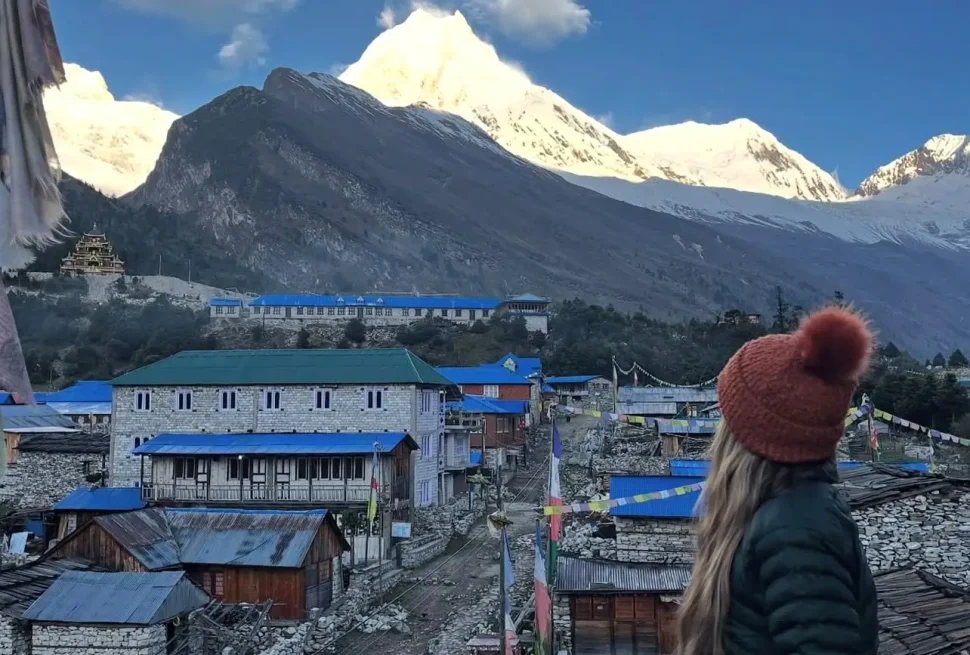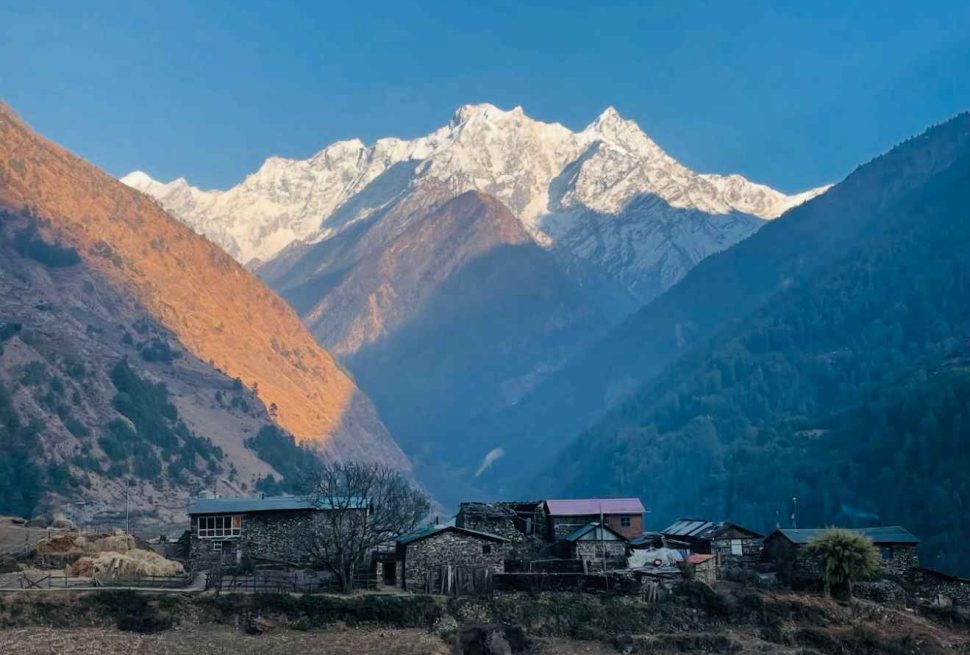
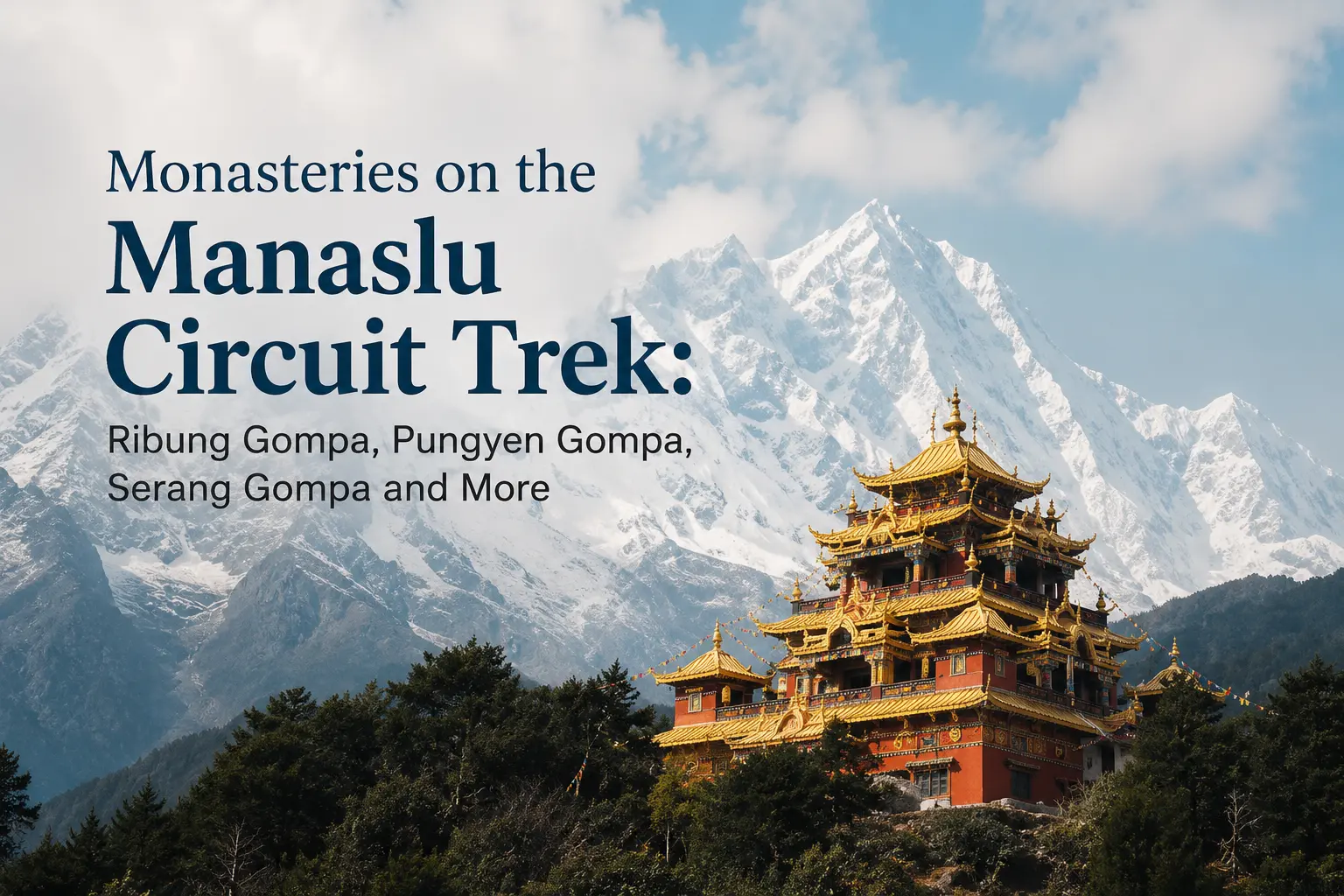
The Manaslu Circuit Trek is one of the few trekking routes in the world where ancient monasteries are not a side attraction — they are woven into the fabric of the journey itself. Every village above Deng has a gompa (monastery) at its centre. Prayer wheels line the main paths. Chortens mark the high passes and river crossings. The daily sound of monastery bells and the smell of juniper incense are as much a part of walking this route as the crunch of gravel underfoot or the sight of Manaslu filling the northern sky. Contact our best manaslu trek company for customised itineraries and expert guidance.
For the Nubri people who have lived in the upper Budhi Gandaki valley for over a thousand years, the monasteries are not historic monuments to visit. They are the living centres of community life, the places where children are educated, where the dead are given last rites, where the calendar of festivals is observed, and where the relationship between the human world and the mountain world is negotiated through prayer, ritual, and the accumulated wisdom of generations of resident monks.
This guide introduces the major monasteries on the Manaslu Circuit Trek and the broader Manaslu Conservation Area, including the extraordinary Serang Gompa. It covers their history, their religious significance, what you will see and experience on a visit, and the etiquette that ensures your presence enriches rather than disrupts these sacred spaces. If you are planning your trek, browse our full range of Manaslu Circuit packages or contact our team to build a custom itinerary around the monastery visits that matter most to you.
The Tibetan Buddhist Tradition of the Nubri Valley
Before walking through any of the monasteries individually, it helps to understand the religious tradition they belong to. The communities of the upper Manaslu valley — Ghap, Namrung, Lho, Shyala, Samagaun, Samdo — practice Tibetan Buddhism, specifically the Nyingma school, which is the oldest of the four main schools of Tibetan Buddhist thought and practice.
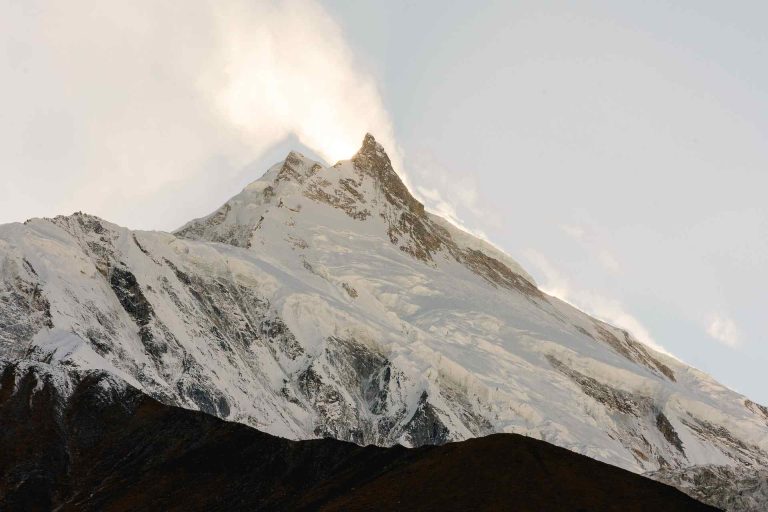
The Nyingma tradition was established by Guru Rinpoche (Padmasambhava), the Indian master who brought Buddhism to Tibet in the 8th century. The Nubri people trace their religious lineage directly to this founding figure and consider the Manaslu region to be a “beyul” — a sacred hidden valley blessed by Guru Rinpoche himself and protected by the mountain deity Pungyen Gompa, whose physical manifestation they believe is the summit of Manaslu at 8,163 metres.
This relationship between sacred geography and living religious practice gives the monasteries of the Manaslu Circuit a quality that distinguishes them from Buddhist temples in urban settings. These are not museums of faith. They are active institutions embedded in communities where the religious and the everyday are not separate categories but aspects of the same continuous experience.
Ghap Monastery — The Gateway Gompa
Ghap Monastery is the first fully Tibetan Buddhist monastery trekkers encounter on the Manaslu Circuit Trek, and it announces everything that lies ahead. Set above the trail on a stone terrace, the monastery complex includes a main assembly hall, several smaller prayer rooms, a kitchen and living quarters for resident monks, and a courtyard ringed with prayer wheels.
The assembly hall is believed to date back more than 500 years, though the current structure has been rebuilt and restored multiple times following damage from earthquakes and the natural deterioration of high-altitude construction. The interior walls carry thangka paintings depicting deities from the Nyingma pantheon, and the main altar holds a large gilded statue of Guru Rinpoche flanked by butter lamps that burn continuously. The ceiling beams are decorated with traditional Tibetan geometric patterns in red, blue, gold, and white that have been repainted by local artists across multiple generations.
The monks at Ghap perform their morning prayers before sunrise, and trekkers who set out early from the lower villages often hear the sound of the monastery drum and the deep drone of the dungchen (long ceremonial horn) drifting down the valley before they reach the village. This is one of the small gifts of early departures on the Manaslu Circuit: the sounds of a monastery morning reaching you before the monastery itself comes into view.
Ribung Gompa — The Monastery Below Manaslu
Ribung Gompa at Lho is the most dramatically situated monastery on the entire Manaslu Circuit. It sits on a rocky promontory above the village with the full north face of Manaslu rising directly behind it, filling the sky in a way that makes every photograph taken here feel almost unreal. On a clear morning in October, the light on Manaslu’s snowfields turns a deep gold in the first hour after sunrise, and the monastery’s whitewashed walls and the red-robed monks moving between buildings create a foreground of colour against that immense backdrop.
The monastery is believed to have been established in the 14th or 15th century, though the exact founding date is uncertain. Local oral history associates the founding with a great Nyingma master who meditated in the caves above Lho and consecrated the site for a permanent religious institution. The current main temple building dates from the 19th century, with significant restoration work completed after earthquake damage in 2015.
Ribung Gompa is the site of the most important annual festival in the Lho village community. If you want to time your Manaslu Circuit Trek around it, contact us in advance. Each spring, typically in April or May, the monks perform the Cham dance — a series of masked ritual dances in the monastery courtyard that dramatize the defeat of negative forces and the protection of the valley community. The dancers wear elaborate painted masks representing protective deities and demons, and the performances are accompanied by the full monastery orchestra of drums, cymbals, and ceremonial horns. The entire valley community attends, dressed in their finest traditional clothing.
Inside the main hall, the most important religious object is a large clay statue of Chenrezig, the Bodhisattva of compassion, with eleven heads and a thousand arms — a form representing the deity’s capacity to see and respond to the suffering of all beings simultaneously. The statue was damaged in the 2015 earthquake and has since been painstakingly restored by skilled craftspeople brought from Kathmandu and from the Tibetan exile community in India.
Pungyen Gompa — Sacred Heart of Samagaun
Pungyen Gompa at Samagaun is the largest and most important active monastery on the Manaslu Circuit. The name itself reveals its significance: “Pungyen” is both the name of the monastery and the name of the mountain deity worshipped by the Nubri community as the spiritual protector of the entire valley. The Nubri people believe that the mountain we call Manaslu is the physical body of the deity Pungyen, and the monastery is both the formal institution that maintains the deity’s worship and the centre of the living religious community that receives the deity’s protection.
The monastery complex at Samagaun is substantial. The main assembly hall can seat more than a hundred monks and community members during major ceremonies. There are separate rooms for different ritual functions: a protector deity chapel, a library of religious texts (many of them handwritten on traditional bark paper), a room for the preparation of ritual objects, and a kitchen that feeds the resident monks year-round. The monastery also maintains a small school where children from the village receive traditional religious education alongside standard Nepali curriculum subjects.
The resident monk community numbers around fifteen to twenty at any given time, though this increases during major festival periods when monks return from study at larger institutions in Kathmandu, Pokhara, and the Tibetan exile communities in India. The monastery is headed by a Lama (religious teacher) whose authority is both spiritual and social — decisions affecting the entire Samagaun community are made with the Lama’s input and blessing.
For trekkers on the 14-day Manaslu Circuit Trek, the acclimatization day at Samagaun is the ideal time to visit Pungyen Gompa. The monastery is open in the mornings for visitors, and if you arrive during the daily morning prayer session (typically beginning before sunrise and concluding around 8 AM), you will hear the full assembly of monks chanting the daily liturgy — a sound that resonates in the chest at altitude in a way that is physically felt as much as heard.
Experience These Sacred Sites in Person
Our guides have personal relationships with the monastery communities along the circuit. We can arrange morning prayer observation, monastery tours, and cultural introductions that independent trekkers cannot access.
Samdo Monastery — Prayers at the Edge of Tibet
The small monastery at Samdo holds a special significance for trekkers who are about to cross Larkya La Pass the following morning. At 3,875 metres, with the Tibetan plateau just kilometres away to the north and the Larkya Glacier visible from the village, Samdo Monastery is the last place of organised religious practice before the high passes and the descent into the Dudh Khola valley.
The monastery is modest in size compared to Pungyen Gompa, but its position and its role in the community give it a weight that physical size cannot measure. It has served as the spiritual anchor for the Samdo community through centuries of extreme high-altitude living: the harsh winters that last six months, the thin air that limits agricultural productivity, the isolation from the wider Nepali world that still shapes daily life here. The monks at Samdo perform regular rituals specifically intended to protect the community from the supernatural dangers associated with the mountains and passes that surround the village on every side.
Many trekkers on the Manaslu Circuit Trek visit the monastery on the afternoon they arrive in Samdo, before the early rest required for the 3 AM pass-crossing departure. A brief sit in the monastery courtyard in the late afternoon, watching the light shift across the snow peaks above while the sound of a distant prayer bell drifts across the bare high-altitude terrain, is a moment of stillness that many trekkers describe as the quietest and most centred they felt on the entire trek.
Serang Gompa — The Hidden Monastery of the Tsum Valley
Serang Gompa is the most significant monastery in the Tsum Valley, a hidden sacred valley branching off the main Manaslu Circuit route to the east. To understand Serang Gompa is to understand why the Tsum Valley is considered by Tibetan Buddhists to be one of the most spiritually charged places in the entire Himalayan region.
The Tsum Valley is a “beyul” — a term from Tibetan Buddhist cosmology meaning a hidden sacred valley blessed and concealed by Guru Rinpoche as a refuge for practitioners and communities in times of spiritual or physical danger. There are only a handful of recognised beyul in the Himalayas, and Tsum is among the most intact and least altered by modernisation. The Tsumba people who live in this valley have maintained their Tibetan Buddhist traditions with a continuity and depth that even the villages of the main Manaslu Circuit cannot quite match.
Serang Gompa sits at approximately 3,800 metres on a rock spur above the Tsum Valley floor, its whitewashed walls and red-painted upper level visible from the main trail below long before you reach it. The monastery is believed to have been established in the 12th or 13th century, which would make it among the oldest surviving Buddhist monasteries in Nepal. Some religious historians argue that the site itself was consecrated even earlier, during the period of Guru Rinpoche’s teaching activity in the 8th century, with the formal monastery structure built by later disciples at a location he had already made sacred.
The main assembly hall of Serang Gompa contains religious murals painted directly onto the stone walls using natural mineral pigments. These murals, depicting the major figures of the Nyingma and Kagyu lineages, are considered among the most significant surviving examples of traditional Himalayan Buddhist wall painting in Nepal. Their age, their quality, and their state of preservation are extraordinary. The deep reds, blues, and golds of the pigments remain vivid after centuries, protected partly by the dry high-altitude air and partly by the regular care of the monastery community.
The religious objects at Serang include several ritual items that the monastery community considers to be direct relics of early masters — physical objects handled by great teachers of the past whose spiritual power is believed to have become embedded in the objects themselves. These relics are not displayed as museum pieces but are used in ongoing rituals, brought out on specific days in the religious calendar and venerated with offerings, incense, and prayer by both monks and lay community members.
The current resident monk community at Serang is smaller than in previous generations, a pattern seen across many remote Himalayan monasteries as younger monks seek education at larger institutions in Kathmandu and India. The monastery is governed by a senior Lama who maintains the ritual calendar and supervises the education of the few young monks still in residence. Community lay members from the surrounding Tsum villages participate in the major festival observances throughout the year.
How to Visit Serang Gompa
Serang Gompa is accessible via the Tsum Valley extension of the Manaslu Circuit, which branches off the main circuit at Jagat or Lokpa and adds approximately six to eight days to the standard route. The Tsum Valley has its own restricted area permit requirement, separate from the main Manaslu Restricted Area Permit, and this must be obtained in advance through a registered trekking agency like Manaslu Treks and Expedition.
The full Tsum Valley route passes through a series of remarkable villages including Chumchet, Nile, Mu Gompa, and Rachen Gompa before reaching the upper valley where Serang Gompa stands. The combined Manaslu Circuit and Tsum Valley trek is one of the most culturally and spiritually rich trekking experiences available anywhere in Nepal. We also offer a longer 23-day Tsum Valley and Manaslu Circuit Trek for those who want to go deeper into both valleys without rushing.
For details on the combined route, see our 19-day Manaslu Circuit with Tsum Valley trek. The additional days required to visit Serang Gompa are among the most worthwhile of any extension available on any Himalayan trekking route.
Mu Gompa and Rachen Nunnery — Tsum Valley’s Other Sacred Sites
The Tsum Valley extension of the Manaslu Circuit passes not only Serang Gompa but two other significant religious institutions that deserve mention.
Mu Gompa sits at approximately 3,700 metres at the head of the Tsum Valley and is the oldest and most revered monastery in the valley. The name “Mu” refers to the sky or space in the Tibetan Buddhist cosmological understanding, and the monastery is associated with sky burial practices that are still performed in the valley. The monastery contains ancient texts, ritual objects, and a large prayer hall that serves the entire upper Tsum community.
Rachen Gompa is a nunnery rather than a monk monastery, housing a community of Tibetan Buddhist nuns who maintain their practice in one of the most remote and challenging environments in Nepal. Rachen is located at around 3,500 metres and the nuns living here have chosen a life of genuine renunciation — away from road access, from reliable electricity, from the comfort infrastructure that most modern people consider basic necessities. The quality of contemplative practice possible in such conditions, and the depth of peace visible in the faces of the senior nuns, is one of the most quietly striking aspects of a visit to the Tsum Valley.
The Role of Chortens and Mani Walls Along the Route
The monasteries are the formal religious institutions of the Manaslu Circuit, but they are only part of the sacred landscape that trekkers move through. The trail itself is lined with smaller religious structures that together constitute a continuous spiritual environment.
Chortens (stupas) are dome-shaped structures that range in size from small roadside cairns to large whitewashed monuments the height of a two-story building. They mark sacred sites, commemorate important religious figures, and are positioned at passes, trail junctions, and village entrances to protect travellers and communities. The correct approach is to walk clockwise around every chorten you pass — a simple gesture that aligns your movement with the solar and spiritual orientation of Tibetan Buddhist sacred space.
Mani walls are long stone structures, sometimes running for fifty metres or more, built from flat stones carved or painted with the mantra “Om Mani Padme Hum” — the mantra of Chenrezig, the Bodhisattva of compassion. Walking clockwise along a mani wall means keeping the wall to your right. These walls are built by community members as acts of religious merit, and some of the older mani walls on the Manaslu Circuit contain stones that were carved by craftspeople who lived several generations ago.
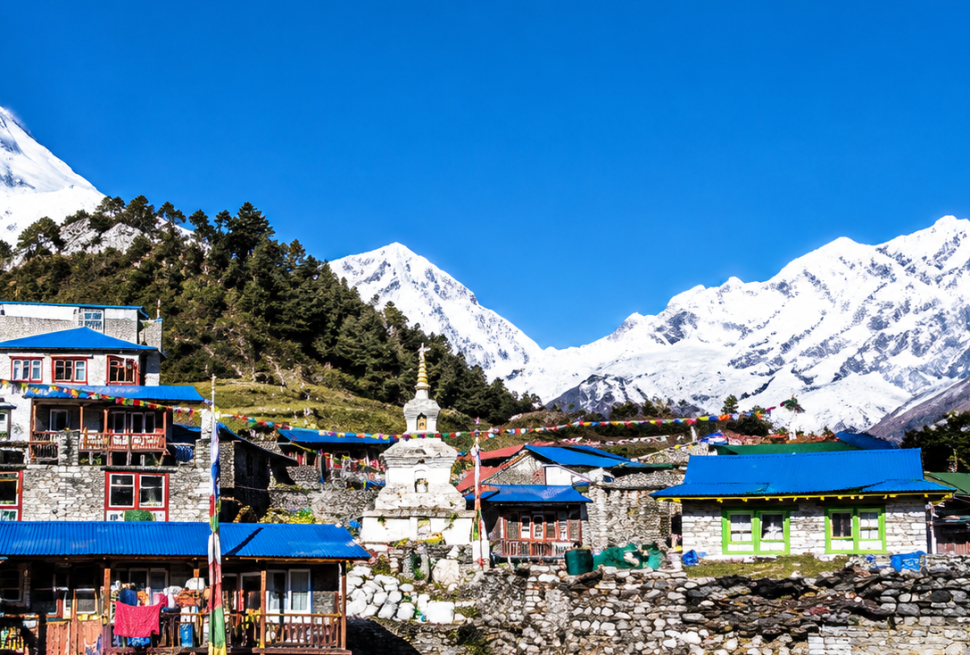
Prayer flag lines strung between high points carry printed mantras into the wind, with the belief that each flutter of the flag sends the mantra outward in all directions, accumulating merit for the person who hung the flags and spreading blessings into the environment. The prayer flags you see in the Manaslu villages are not decorative items. They are working religious objects replaced regularly as the old ones fade and disintegrate in the fierce mountain weather.
What to Expect Inside a Manaslu Valley Monastery
Many trekkers have never been inside a Tibetan Buddhist monastery before arriving on the Manaslu Circuit, and a brief orientation helps make the experience richer and more respectful.
The main assembly hall typically faces east and is entered through a doorway flanked by painted protector deity figures. You will remove your shoes at the threshold and leave them outside. The interior is dim after the bright mountain light outside and your eyes need a moment to adjust. The smell of butter lamps, juniper incense, and the faint sweetness of old painted surfaces surrounds you immediately.
The main altar faces you as you enter, typically raised on a platform and holding a central statue (usually Guru Rinpoche, Shakyamuni Buddha, or Chenrezig depending on the specific monastery lineage), flanked by smaller statues, offering bowls filled with water, food offerings, butter lamps, and ritual objects. In front of the altar are long low benches where the monks sit during prayer, their cushions and personal prayer books arranged in place.
The walls are covered with painted murals and hanging thangka paintings. The ceiling is low and supported by painted wooden pillars. The overall effect is intimate, layered, and completely unlike any Western religious interior. Take your time. Look slowly at the paintings. Notice the detail in the altar arrangements. Ask your guide to explain specific iconographic elements if you are curious — a good guide can read these images like a visual scripture.
Photography in Manaslu Valley Monasteries
The question of photography in monasteries is one that trekkers sometimes handle poorly, creating lasting negative impressions with communities that have been patient and welcoming hosts for decades. A few principles help navigate this well.
Always ask before photographing inside an assembly hall. The default assumption should be that photography is not permitted unless you are told otherwise. Many monasteries do allow photography of the exterior and the courtyard freely but restrict interior photography to protect the privacy of prayer practices and the dignity of sacred objects.
Never photograph monks during active prayer or ritual without explicit permission. A monk in the middle of a prayer session is no more available for photography than a surgeon in the middle of an operation.
Photographing the exterior of monasteries, the surrounding landscape, and general village scenes is usually unrestricted. Photographing individual community members, particularly older people and women, should always involve a smile, a gesture, and a responsive sign of consent before you raise your camera.
If you are in doubt, put the camera away. The memory you form by simply being present and attentive in a 600-year-old monastery above 3,000 metres with Manaslu visible through the doorway is not diminished by not having a photograph of it.
Monastery Summary: The Sacred Sites of the Manaslu Circuit
| Monastery | Location | Altitude | Age | Key Significance |
|---|---|---|---|---|
| Ghap Monastery | Ghap Village | 2,160m | 500+ years | First Tibetan Buddhist gompa on circuit, ancient thangka paintings |
| Namrung Gompa | Namrung Village | 2,660m | 300+ years | Largest mid-valley monastery, regular morning prayers |
| Ribung Gompa | Lho Village | 3,180m | 600+ years | Best Manaslu view, Cham dance festivals, ancient Chenrezig statue |
| Pungyen Gompa | Samagaun Village | 3,520m | 400+ years | Largest active monastery, Tiji festival, valley protector deity |
| Samdo Monastery | Samdo Village | 3,875m | 200+ years | Highest permanent monastery, pre-pass spiritual stop |
| Serang Gompa | Tsum Valley | ~3,800m | 700+ years | Oldest gompa in region, ancient murals, beyul sacred site |
| Mu Gompa | Upper Tsum Valley | ~3,700m | 500+ years | Most revered Tsum Valley monastery, ancient texts and relics |
| Rachen Nunnery | Tsum Valley | ~3,500m | 300+ years | Active nunnery, contemplative community, remarkable setting |
Monastery Etiquette: What to Do and What to Avoid
The monasteries of the Manaslu Circuit are active places of worship, not tourist attractions. The communities that maintain them have been welcoming outsiders with patience and generosity for decades. A few clear guidelines will make your visit respectful, meaningful, and genuinely welcomed by the monks and families who call these places home.
- Remove your shoes before entering any monastery building, including side rooms and protector chapels
- Walk clockwise around all chortens, prayer wheels, and mani walls — always keep them to your right
- Spin prayer wheels clockwise as you pass
- Dress modestly — cover your shoulders and knees before entering
- Sit quietly and observe if monks are in the middle of prayers
- Ask your guide to explain the paintings and statues — curiosity is welcomed
- Leave a small donation in the offering box at the entrance or altar
- Greet monks and caretakers with a respectful “Tashi Delek” (the Tibetan Buddhist greeting)
- Ask permission before photographing inside the assembly hall
- Accept any blessed cord or red thread a monk ties around your wrist — it is a genuine blessing
- Never point your feet toward the altar, statues, or sacred objects — sit with your legs crossed or to the side
- Do not touch statues, thangka paintings, ritual objects, or personal prayer items on the monks’ benches
- Do not step over any religious object or text lying on the floor
- Do not enter a monastery wearing a hat or sunglasses
- Do not speak loudly or laugh inside the assembly hall
- Never photograph monks during active prayer or ritual without asking first
- Do not walk counterclockwise around any chorten or mani wall, even if it seems like a shortcut
- Do not move or rearrange mani stones, prayer flags, or offering items
- Do not fly a drone directly over monastery buildings without the monastery’s permission
- Do not enter areas marked as restricted or closed — some rooms are for resident monks only
Planning Your Visit Around the Festival Calendar
The monasteries of the Manaslu Circuit are most alive during their festival periods, when the entire community gathers, the monks perform elaborate rituals, and the ordinary boundaries between daily life and sacred practice dissolve entirely. Planning your trek around these festivals is one of the best decisions any culturally motivated trekker can make.
The most important festivals are tied to the Tibetan lunar calendar and vary by a few weeks each year in terms of their Gregorian calendar equivalents. In general terms: Losar (Tibetan New Year) celebrations occur in January or February and are observed at all monasteries with community gatherings and prayer ceremonies. Tiji at Pungyen Gompa takes place in April or May and is the most spectacular festival on the circuit. The autumn months of October and November are quieter in terms of major festivals but the monasteries are active with regular prayer and the community preparations for winter, which is itself a spiritually significant period of intensive meditation practice for the monk community.
We at Manaslu Treks and Expedition maintain current information on the festival calendar and can adjust itinerary start dates to incorporate major monastery festivals into your trek schedule. This is one of the forms of customisation that makes a guided trek with a knowledgeable local operator genuinely different from an independent journey. Meet our guides, read trekker reviews, or get in touch to plan your dates around the festival that matters most to you.
Choose Your Manaslu Trek — Packages That Include These Sacred Sites
Every trek we run passes through the monastery villages described in this guide. The right package for you depends on how much time you have and how deep you want to go into the Tsum Valley. All packages are run by our local Nubri-speaking guides with personal relationships in the monastery communities — no advance payment required.
Not sure which length suits you? Browse all Manaslu packages or WhatsApp us and we will recommend the best fit based on your available dates and interests.
Frequently Asked Questions
Trek the Manaslu Circuit with Cultural Depth
Our guides speak Tibetan and Nepali and have personal relationships with the monastery communities. Contact us to plan your monastery-focused Manaslu trek.
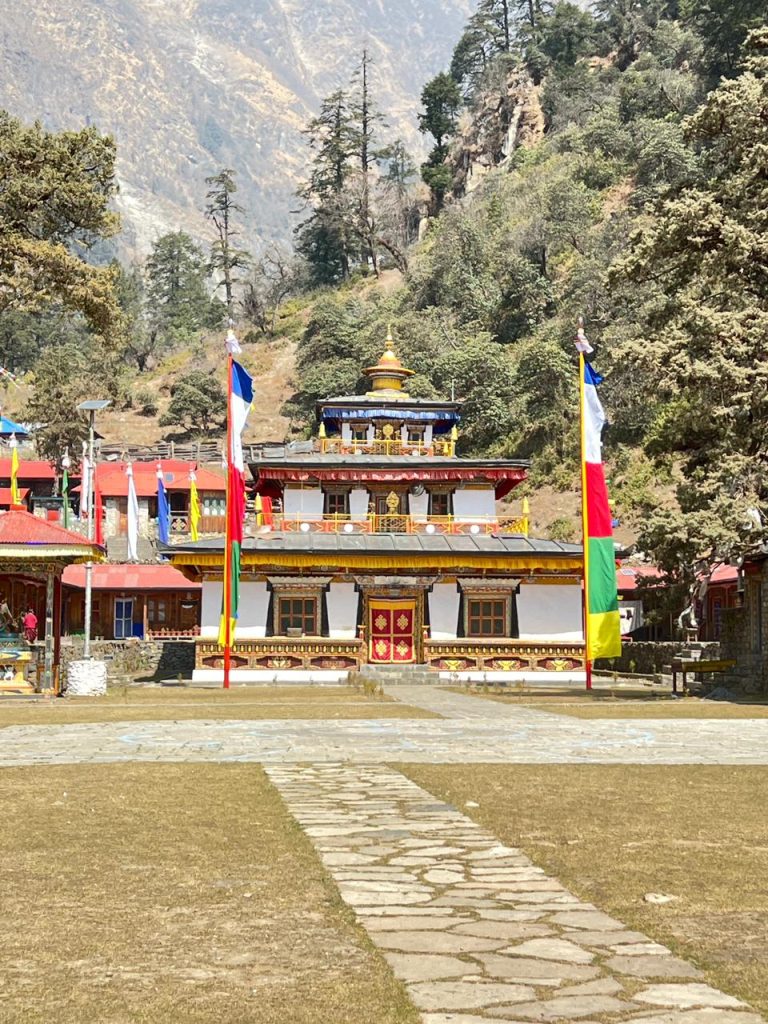
Namrung Gompa — The Mid-Valley Monastery
Namrung sits at 2,660 metres in the zone where the lower subtropical forest of the Budhi Gandaki valley begins to give way to the open high-altitude terrain above. The monastery here is the largest religious institution between Ghap and Lho, and for many trekkers it represents the first overnight stop at an altitude that genuinely begins to feel like the mountains. The village surrounds the monastery on three sides, and the gompa courtyard acts as the social centre of Namrung in the same way a village square does in other cultures.
The Namrung Gompa complex includes a main assembly hall, a smaller protector chapel to the side, a row of large prayer wheels along the entrance path, and several painted chortens around the outer perimeter. The main hall holds a central altar with a large Shakyamuni Buddha statue and walls covered in thangka paintings that trace the complete life story of the historical Buddha from birth to enlightenment. The paintings are in a more recent style than those at Ghap but they are well executed and the caretaker monk is usually happy to explain the narrative sequence to visiting trekkers.
Namrung is also the point where the Tsum Valley route branches off the main circuit, which gives the village an additional significance as a trail junction. Trekkers heading into the Tsum Valley will spend their last evening on the main circuit at Namrung before turning east. Those continuing on the standard Manaslu Circuit head north toward Lho the following morning. In both cases, the Namrung Gompa morning prayers are worth rising early for — the resident monks begin before sunrise and the sound carries clearly through the cold dawn air of the village.
Best Time to Visit the Monasteries of the Manaslu Circuit
The monasteries of the Manaslu Circuit are open year-round, but the experience of visiting them changes significantly by season. The best time to trek the Manaslu Circuit for monastery visits depends on whether you are prioritising clear mountain views, festival attendance, or quiet immersive time with the monk communities.
How Long to Spend at Each Monastery
| Monastery | Altitude | Minimum Visit | Recommended Time | Best Moment |
|---|---|---|---|---|
| Ghap Monastery | 2,160m | 20 minutes | 45 minutes | Early morning, hear the dungchen horn |
| Namrung Gompa | 2,660m | 20 minutes | 40 minutes | 5:30 AM morning prayers |
| Ribung Gompa — Lho | 3,180m | 30 minutes | 1.5 hours | Sunrise — Manaslu north face behind the gompa |
| Pungyen Gompa — Samagaun | 3,520m | 45 minutes | 2 hours | Acclimatization morning — attend full prayer session |
| Samdo Monastery | 3,875m | 15 minutes | 30 minutes | Pre-pass afternoon — sit quietly in the courtyard |
| Serang Gompa (Tsum) | ~3,800m | 1 hour | Half day | Mural viewing — morning light inside the hall |
| Mu Gompa (Tsum) | ~3,700m | 45 minutes | 2 hours | Interact with resident monks, view ancient texts |
| Rachen Nunnery (Tsum) | ~3,500m | 30 minutes | 1 hour | Early afternoon — nuns often visible in courtyard |
Permits Required to Visit the Monasteries
Every monastery on the Manaslu Circuit sits within a restricted or protected area of Nepal. Unlike the Everest or Annapurna regions, you cannot visit these sacred sites independently — a registered trekking agency and the correct permits are legally required. This restriction is part of why the Manaslu valley has retained its cultural and ecological integrity far better than more open trekking routes.
Trek Difficulty and Fitness: What Monastery Visits Require
The monasteries of the Manaslu Circuit sit at altitudes ranging from 2,160 metres (Ghap) to 3,875 metres (Samdo). Visiting them is not technically difficult — there is no climbing, scrambling, or specialist equipment required. What matters is acclimatization, a reasonable level of fitness, and a willingness to walk for five to eight hours on most days.
The standard Manaslu Circuit Trek is rated as a hard to strenuous trek because of cumulative altitude gain, multi-day duration, and the Larkya La Pass crossing at 5,106 metres. However, the monastery visits themselves are low-effort additions to each day — most gompas are directly on the main trail or a ten-minute walk above the village.
Trekkers who choose the 14-day itinerary benefit from an additional acclimatization day at Samagaun that makes the Pungyen Gompa visit genuinely relaxed rather than rushed. The Luxury Manaslu Circuit Trek uses the same longer schedule and also provides a private guide who can facilitate introductions with monastery communities that standard group trekkers do not typically access.
First-time high-altitude trekkers are well suited to the Manaslu Circuit with the right preparation. You do not need prior trekking experience in Nepal to visit these monasteries — you need cardiovascular fitness, comfortable boots, and the patience to walk slowly at altitude. If you are unsure whether the Manaslu Circuit suits your fitness level, WhatsApp our team and we will give you an honest assessment based on your background.
Manaslu Monasteries vs Everest Region Monasteries: What Is Different?
Many trekkers who have walked the Everest Base Camp route and visited Tengboche or Pangboche monasteries ask how the Manaslu Circuit monastery experience compares. It is a fair question, and the honest answer is that they are different in several important ways — not better or worse, but shaped by different histories, different levels of external exposure, and different cultural contexts.
- Restricted access area — far fewer trekkers each year
- Communities have had less sustained exposure to mass tourism
- Monastery visits feel genuinely unscripted and personal
- Nubri and Tsumba people maintain older pre-modern traditions with less outside influence
- Beyul sacred valley status gives Tsum Valley monasteries a cosmological depth that Khumbu does not share
- Serang Gompa and Mu Gompa are among the least visited significant monasteries in Nepal
- Guides with personal family connections to the monastery communities
- Tengboche is the most famous monastery in Nepal — iconic, well-documented
- Thousands of trekkers pass through per month in peak season
- Monastery visits are more structured and predictable
- Sherpa Buddhist culture is well-known internationally — more accessible background material
- Mani Rimdu festival at Tengboche is one of the most photographed events in Himalayan trekking
- Easier access — no restricted area permit required for the main EBC route
- More tourist infrastructure immediately around the monasteries
For trekkers whose primary motivation is cultural immersion and spiritual depth rather than mountain views or trail fame, the Manaslu Circuit monasteries offer an experience that is harder to find anywhere in the Himalayas. The combination of restricted access, living Tibetan Buddhist tradition, and extraordinary mountain setting makes this one of the most compelling cultural trekking routes in Asia. Our 19-day Manaslu Circuit with Tsum Valley is particularly suited to trekkers making this comparison — the depth of the Tsum Valley monastery experience has no direct equivalent on any open trekking route in Nepal.
Glossary: Tibetan Buddhist Terms You Will Encounter on the Trek
Walking the Manaslu Circuit Trek without any background in Tibetan Buddhist culture is perfectly fine — our guides explain everything in context on the trail. But having a basic vocabulary before you arrive makes each monastery visit richer and more meaningful. These are the terms you will encounter most frequently.
For a deeper introduction to the religious and cultural context of the Manaslu Circuit, our local guides — many of whom were raised in the Nubri valley communities — provide informal cultural briefings each evening at the tea house. This is one of the genuine advantages of trekking with a locally rooted company rather than an international operator with no direct connection to the communities you are visiting. Read what previous trekkers say about these conversations on our reviews.